What a human hair wig costs
Everyday human hair lace fronts often begin around two hundred dollars. Much of the price pays for cap construction and hand work. At lower prices, synthetic fibres and blends are more common; higher prices often reflect added length, colour work or an in-person fitting service.
Typical price bands
Prices for human hair wigs spread over more than an order of magnitude, which is why the question is so hard to answer from search results alone. The bands are real, though, and they’re fairly stable:
Under about $80. Synthetic, or a human hair blend, or a very short human hair piece. There’s nothing wrong with synthetic — see human hair versus synthetic for what you gain and lose — but a full-length human hair lace wig cannot be made and shipped for this money. If a listing claims otherwise, one of the claims is doing the lying.
Roughly $100 to $150. Short human hair, a machine-wefted cap rather than a hand-tied one, or a half wig or U-part where there’s less hair and much less lace involved. Genuine value here, provided you know which corners have been cut.
Roughly $180 to $280. The mainstream band for a full human hair lace front wig in ordinary lengths. This is where the wigs on this site sit, and it’s the band we’d point most people at, because it’s where the price stops buying dramatic improvements and starts buying refinements.
Roughly $300 to $600. Long lengths, denser or more fully hand-tied caps, multi-tone colour work done by hand, or a seller who includes fitting and a trim in the price.
One thing the bands above leave out is delivery, which is part of what you actually pay and varies more between sellers than the wigs do. Check it before you compare two prices. Ours is on SoftWig’s shipping policy.
Above $800. This range includes made-to-measure caps, some fitted medical wigs and boutique services that bundle the piece with consultation and adjustment. The service and custom work become a substantial part of the purchase.
What the price pays for
Not the hair, mostly. That’s the part people get wrong.
Labour is the biggest line. On a lace front, individual hairs are knotted to the lace by hand at the hairline — thousands of them, one at a time. Extend that to a whole cap, as a full lace wig does, and the labour multiplies. This is why two wigs with the same hair can differ by hundreds of dollars.
The hair, priced by length. Human hair is a commodity sold by weight, and long lengths are disproportionately expensive because long, undamaged donor hair is genuinely scarce. A wig doesn’t cost twice as much at 24 inches as at 12 because it has twice the hair — it costs more than that, because the hair itself is rarer.
Cap construction, which almost never appears in the spec list. Hand-tied crowns, seamless wefts, a comfortable lining and elastic that doesn’t relax after a month are all real costs and none of them photograph.
Consistency. Matching hair across a whole wig so the ends aren’t thin and the colour doesn’t drift mid-length means rejecting a lot of material. Cheap wigs are often cheap because nothing was rejected.
After-sales support: returns, replacements and a person who can resolve a parcel problem. Those services also form part of the price.
Length has the clearest effect on price
Length. On most ranges it’s the only variable you choose that changes what you pay, and the increments aren’t linear — each step up costs a little more than the last, and the steps get noticeably more expensive past 20 inches.
That has a practical consequence worth planning around: the cheapest wigs in any range tend to be the shortest ones, and the shortest ones also survive daily wear better, because there’s less hair to abuse and less friction at the nape. Buying two inches shorter than your instinct is the only decision in wig shopping that saves money and extends wear life at the same time. How length translates onto your own frame is worth reading before you commit to a number.
What generally doesn’t change the price: cap size, and lace width. Both are chosen from the same price, which means there is nothing to be saved by ordering a cap that doesn’t fit or a lace panel that’s wrong for how you part your hair. Get those right for free.
Where price stops helping
Two things money can’t buy, and it’s better to know before you spend.
It can’t buy resistance to friction — the nape of a wig wears at a rate set by your coat collar, not by your budget. And it can’t buy lace that doesn’t tear, because fine lace is fine lace at every price. We’ve set out what actually wears out first, and when rather than repeat it here, but the short version is that both failures are handling problems, and handling is free.
Density is a third case, slightly different: at this price the ready-to-wear listings have all converged on 180%, so paying more won’t get you a lighter wig. Why that is, and what to do if it’s too much hair for you, is a separate question with a cheap answer.
If the budget is fixed, spend in this order
- Fit first, because it’s free. A cap that fits is the difference between a wig you wear and a wig you tolerate by hour six. Measure properly before you choose anything else.
- Then the hairline. If any money is going somewhere optional, it should go to the front edge — the lace grade and how the knots are finished. It’s the part people notice. What HD lace is and isn’t covers what you’re buying.
- Then length, downwards. Every inch you don’t buy is money saved and wear life gained.
- Colour last. Multi-tone work is genuinely skilled and genuinely more expensive. A single natural shade at a lower price is not a worse wig, and it’s a much more forgiving first purchase.
The calculation that changes the answer
Sticker price is the wrong number for anything you’ll wear regularly. Cost per wearing is the right one, and it reorders the choices.
A mid-priced wig worn three times a week for a year works out at a couple of dollars a wearing. The same money spent on something cheap enough to need replacing twice in that year costs more, not less, and involves two more rounds of hoping the parcel matches the photographs. It’s also the reason the second-cheapest option usually beats the cheapest: the gap in price is small and the gap in how many wearings you get out of it isn’t.
For daily wear, the same budget may work better across two mid-priced wigs than a single premium piece. Rotation gives each cap time to dry and reduces repeated handling; the wear-life guide works through that calculation.
When a price is too good
A listing that promises 100% human hair, HD lace, a wide lace panel and 22 inches of length for under a hundred dollars is describing something that doesn’t exist at that cost. Usually one of four things is going on: the hair is a blend, the length is measured while the hair is stretched, the lace is a coarser grade than the label, or the density thins out badly through the last few inches.
None of that is detectable from a photograph, which is exactly why the price is the signal. If a figure looks impossible for the specs listed, believe the figure.
What to look for on a listing
- Material
- 100% human hair, stated plainly — the one claim worth checking before you judge a price
- Density
- 180% on essentially every listing in this band, so a higher figure isn't what you're paying for
- Length
- The spec that moves the price most; the steps get more expensive past 20 inches
- Cap
- Cap size and lace width usually cost the same, so there's nothing to save by fitting badly
Questions people ask
Why are two wigs with identical specs priced differently?
Usually cap construction and where the hair came from — neither of which appears in the spec list. Hand-tied sections, a fully hand-tied crown, or hair from a single donor batch all cost more to produce and none of them show up as a number on the listing. Some of the gap is also just margin, and that part is worth shopping around on.
Is a $600 wig twice as good as a $200 one?
No. The improvement curve flattens hard somewhere in the middle band. Going from a very cheap wig to a mid-priced one changes almost everything; going from mid to expensive usually buys length, a more elaborate cap, or colour work you may not need. If you're new to wigs, the mid band is where the money works hardest.
Are cheap human hair wigs ever worth buying?
A short one can be. Length is the most expensive raw ingredient, so a 12 or 14 inch human hair wig at a low price is plausible in a way that a 26 inch one at the same price isn't. If a long wig is priced like a short one, the length, the density or the "human hair" part is usually not what the listing says.
Should I buy one expensive wig or two mid-priced ones?
For daily wear, two. Alternating them roughly doubles the life of both, because most wig damage is friction and rest is the only thing that reduces it. One wig worn every day and one worn never is the arrangement most people regret.
Why does a long wig cost so much more than a short one?
Because long donor hair is genuinely scarce, and the price of hair rises faster than its length. A 24 inch wig isn't twice the hair of a 12 inch one at twice the cost — it's the same amount of labour applied to a raw material that costs disproportionately more per inch. This is also why length is usually the only spec on a listing that changes the price.
Matching wigs
What we'd point you at
Filtered on price. Cap, lining and attachment aren't in the catalogue data, so check those on the product page.
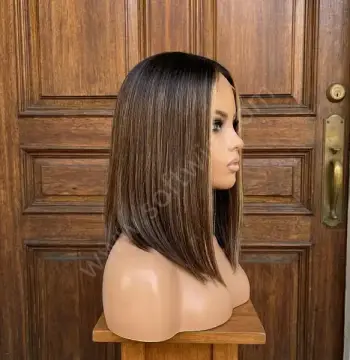
Ombre Blonde Brown with Highlights Sleek Straight HD Lace Front Human Hair Wig Short Bob Silky Soft for Casual Outings
- Lengths
- 10" · 12" · 14" · 16"
- Lace
- 13x4 Lace · 13x6 Lace
- Cap
- Small · Medium · Large
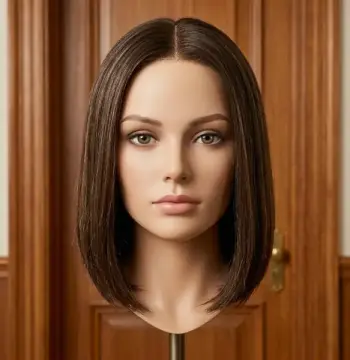
Short Straight Bob HD Lace Front Wig 14" Chocolate Brown Balayage Hand-Dyed Human Hair
- Lengths
- 10" · 12" · 14" · 16"
- Lace
- 13x4 Lace · 13x6 Lace
- Cap
- Small · Medium · Large
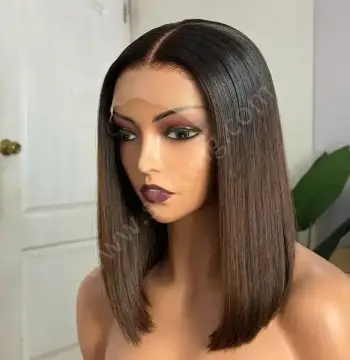
Gradient Ombre Brown Silky Straight HD Lace Front Human Hair Wig Short Bob for Bridal Hairstyles
- Lengths
- 10" · 12" · 14" · 16"
- Lace
- 13x4 Lace · 13x6 Lace
- Cap
- Small · Medium · Large

HD Lace Front Human Hair Wig Honey Blonde Straight Bob Pre-Plucked Natural Hairline Hair
- Lengths
- 10" · 12" · 14" · 16"
- Lace
- 13x4 Lace · 13x6 Lace
- Cap
- Small · Medium · Large