13x4 or 13x6 lace?
The numbers are inches of lace — 13 across, then 4 or 6 deep. The extra two inches on a 13x6 buys you parting freedom. If you part in one place and leave it, that's freedom you'll pay for and never use.
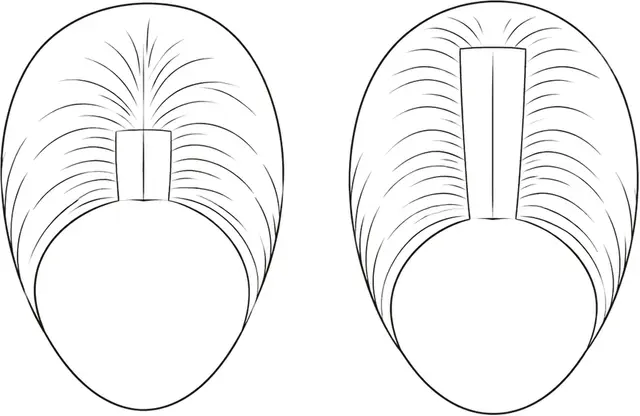
| Dimension | 13x4 lace | 13x6 lace |
|---|---|---|
| Lace area | 13 inches across the front, 4 inches deep | 13 inches across the front, 6 inches deep |
| Parting | Comfortable anywhere in the front few inches | Can be parted much further back, including a deep centre part |
| Best for | One habitual part you don't move | Changing the part, deep side parts, pulling hair back |
| Blending work | Less lace to tint and lay | More lace, so slightly more work to make it disappear |
| Durability | Smaller lace area, marginally less to damage | Larger area, and the extra depth sees more handling |
| Price | Usually the cheaper of the two | Usually a small premium |
Pick 13x4 lace if
You part your hair in the same place every day and have no plans to change it. You'd rather have less lace to blend and less to go wrong. Most people are honestly in this group and buy the other one anyway.
Pick 13x6 lace if
You move your part around, wear a deep side part, or like pulling the hair back off your face. All three expose lace further back than a 13x4 covers, and that's exactly the gap the extra two inches fills.
It’s a measurement, not a grade
The most useful thing to understand about these numbers is that they aren’t a quality tier. A 13x6 is not a better wig than a 13x4. It’s a wig with more lace.
Both numbers are inches. Thirteen across the front, matching roughly ear to ear. Then four or six inches running back from the hairline toward the crown. That second number is the only thing that changes.
Everything else people attach to these labels — hair quality, knot bleaching, density, cap construction — is independent. You can have an excellent 13x4 and a mediocre 13x6.
What the extra two inches buys
Parting freedom, and nothing else.
Here’s the mechanism. When you part hair, you expose the base underneath along the part line. If that base is lace, and the lace is tinted properly, it reads as scalp. If the part runs off the back edge of the lace, you’re now exposing cap — and cap does not read as scalp under any circumstances.
So the question isn’t “which is better”, it’s how far back does your part go?
- A centre part, worn where most people wear it, sits comfortably within four inches.
- A part taken deep toward the crown runs past four inches.
- A deep side part sweeps hair across and exposes lace further back on one side.
- Pulling hair back off the face — half up, pushed back — exposes more depth than any part does.
If you do the first thing only, 13x4 covers you. If you do any of the others, the extra two inches is doing real work.
Make the decision from your usual part
Most people, if they think about it properly, part their hair in one place and leave it there. Not because they lack imagination — because it suits their face and they worked that out years ago.
Those people buy a 13x6 anyway, on the reasoning that more is better and they might want the option one day. Then they part it in the middle every day for two years.
What they’ve bought is a slightly larger area of lace to tint, lay flat and keep from tearing, in exchange for a capability they don’t use. That’s not a disaster. It’s just not the upgrade it felt like at the checkout.
The counter-case is real too: if you genuinely like moving your part, being unable to is a daily irritation, and no amount of saved money makes up for it.
Choose from the part you wear on an ordinary day. A fixed front part fits comfortably within 13x4; regularly moving it deeper or farther back is a clear reason to choose 13x6.
If you’re not sure
Start with 13x4.
Wear it for a couple of months. If at some point you find yourself wanting to move the part and not being able to, you’ve learned something concrete, and 13x6 becomes an easy and well-informed decision on your next wig.
If you never notice the limitation — which is the more common outcome — you’ve saved money and given yourself less lace to look after. Either way you end up knowing something you can only find out by wearing one.
Questions people ask
Is 13x6 just better?
No — it's bigger. More lace is more parting freedom and also more surface to tint, lay and eventually damage. If you don't use the freedom, you've bought work rather than benefit.
What do the numbers actually measure?
Inches. Thirteen inches across the front of the head, and then either four or six inches back from the hairline. The first number is the same on both, so the only variable is depth.
Can I part a 13x4 in the middle?
Yes, comfortably. A centre part sits well within four inches of depth. What you can't do is take that centre part far back toward the crown — that's where you'd run off the lace and hit the cap.
Which is easier for a beginner?
13x4, marginally. Less lace means less to tint, less to lay flat, and less to get wrong while you're learning. If you're unsure, start there and upgrade if you find yourself wanting to move the part.
From the catalogue
Where most people start
This page doesn't narrow the catalogue, so these are simply well-reviewed lace fronts rather than a match to anything above.
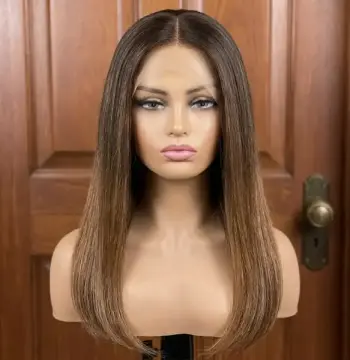
18" Ombre Dark Brown Transition Silky Straight HD Lace Front Human Hair Wig for Women
- Lengths
- 12" · 14" · 16" · 18" · 20" · 22" · 24"
- Lace
- 13x4 Lace · 13x6 Lace
- Cap
- Small · Medium · Large

HD Lace Front Human Hair Wig Honey Brown Straight Middle Part Pre-Plucked Natural Hairline Brazilian Hair
- Lengths
- 12" · 14" · 16" · 18" · 20" · 22" · 24"
- Lace
- 13x4 Lace · 13x6 Lace
- Cap
- Small · Medium · Large

Unprocessed Virgin Long Wave Ombre Brown with Highlights HD Lace Front Human Hair Wig for Special Occasions
- Lengths
- 12" · 14" · 16" · 18" · 20" · 22" · 24"
- Lace
- 13x4 Lace · 13x6 Lace
- Cap
- Small · Medium · Large

Premium HD Lace Front Wig Auburn Red Brown Body Wave 100% Human Hair
- Lengths
- 12" · 14" · 16" · 18" · 20" · 22" · 24"
- Lace
- 13x4 Lace · 13x6 Lace
- Cap
- Small · Medium · Large