Method
How we decide what to recommend
Short version: a small set of written rules, applied to product data pulled straight from the shop's catalogue. No model deciding in the background, and nothing hand-picked to shift stock.
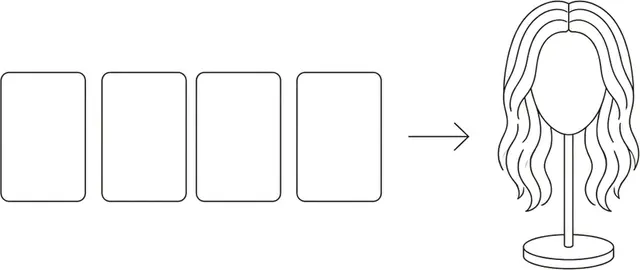
The recommendation is a rule
When you finish the Wig Finder, what happens next isn't a model making a judgement call. Your four answers go into a list of rules that a person wrote and that we can point at. One rule says a first-time buyer who wants a natural result is better served by a moderate density than a very high one. Another says daily wear pushes you towards a glueless cap, because you'll be putting it on and taking it off far more often than someone wearing a wig to one wedding.
That's why the result page lists which of your answers drove which part of the suggestion. If a rule doesn't apply to you — plenty won't — you can see it and override it on the spot, rather than being handed a black-box answer to trust or ignore wholesale.
We check this regularly in a fairly blunt way: run every possible combination of answers through the rules and count how many genuinely different recommendations come out the other side. If a quiz gives almost everyone the same answer, the quiz is theatre. Ours has to clear a minimum before it ships.
Where the product details come from
The factual side — length, texture, colour, density, cap size, lace type, price, whether it's in stock — is read directly from the SoftWig catalogue when this site is built, not typed in by hand. That matters more than it sounds: hand-maintained product lists go stale quietly, and a stale list means we'd be sending you to a price that changed or a wig that's gone.
The judgement side is ours, but be clear about the level it works at: it's written into the rules and into each page, not attached to individual wigs. A page decides what it's looking for — this texture, this length band, this family of shades, a bob, bangs — and the catalogue is filtered against that. What we don't currently have is a per-product layer saying "this one suits a first-time buyer" or "this one is high-upkeep." The scaffolding for it exists and it's empty, so nothing on this site depends on it today. When there's something real in it, this page will say so.
When stock on an exact spec is thin, we widen one filter at a time — bangs first, then cut, shade, length, and texture last — and the page tells you which one we widened. What we won't do is quietly pad the list out with whatever happens to be in stock: if a recommendation can't be filled without abandoning every filter, the build fails and the page doesn't ship.
What we don't do
- We don't take payment for placement. No brand pays to appear in a recommendation, because we only recommend from one catalogue — our own — and we say so everywhere.
- We don't rank by margin. The rules don't know what a wig costs us, and they don't rank by what it costs you either — price is not a ranking criterion. The Wig Finder doesn't ask your budget for the same reason: a question whose answer can't change the answer is a question not worth asking.
- We don't dress up guesses as data. Where we say something is common, that's an editorial judgement from what we see repeatedly, and we phrase it that way rather than inventing a percentage.
When we'd rather you didn't buy yet
Some situations aren't a shopping problem. Sudden or patchy hair loss, a scalp that's broken or painful, an upcoming course of treatment — those are worth a conversation with a doctor or dermatologist first, and where a page touches on them we say so rather than steering you towards a product. A wig will still be there next week.
Read the commercial disclosure for the money side, or who writes this for the people side.
These rules were last reviewed on 2 August 2026.