How wig density affects weight and volume
Density is how much hair is attached to the cap, given as a percentage against an average head. It's the spec that decides weight, heat and how obviously a wig reads as a wig — and in ready-to-wear human hair the listings cluster hard at 180%, so in practice the levers you have are length and having a stylist thin it.
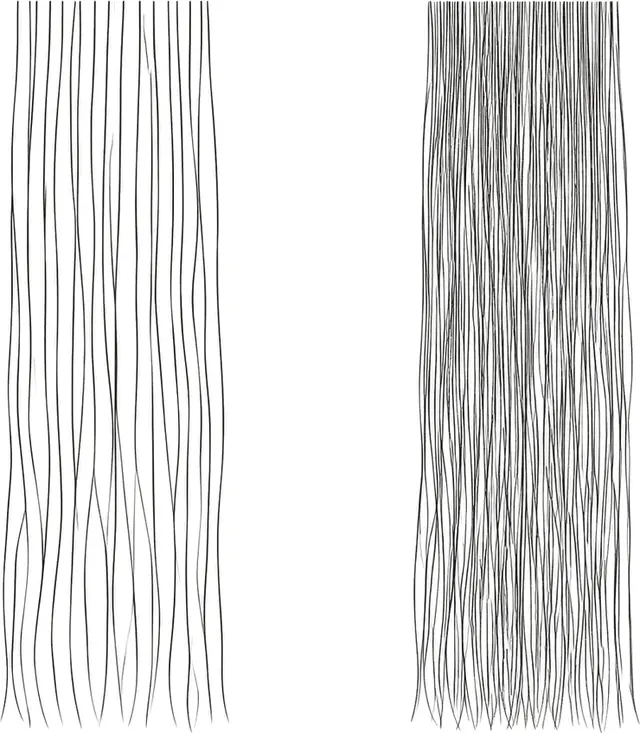
What the number means
Density is how much hair is attached to the cap. It’s expressed as a percentage, benchmarked loosely against the amount of hair a typical head grows — so 100% is meant to approximate an average head, and 180% is a bit under twice that.
“Loosely” is doing real work in that sentence. There’s no industry standard behind these figures, no test, and no body checking them. One manufacturer’s 180% is another’s 200%. What you can rely on is the direction: within a single seller’s range, a higher number means more hair.
Here’s the part that surprises people, and it follows from the paragraph above rather than from any published figure: since 100% is meant to stand for an average head, anything approaching twice that is by definition well past what most people grow. Read against the same rough scale, the bands that sit closest to real hair on most adults are the 130–150% ones — and lower still if your own hair has thinned. Treat that as reading the sellers’ own scale back at them, not as a measured standard; there isn’t one.
Which means the spec you’ll be offered on most ready-to-wear listings is roughly a third more hair than the head it’s going on would grow.
Why ready-to-wear listings cluster at 180%
Because photographs sell wigs, and dense hair photographs well.
A wig at 130% density looks perfectly normal on a person and slightly sparse in a product shot, where it’s competing against a grid of thumbnails all trying to look luxurious. A wig at 180% looks expensive in that grid. Buyers click the full one, sellers stock the full one, and manufacturers make the one that sells.
We’re in that market too, and it’s worth being direct about it: every human hair lace front we recommend is built at 180%. Not because we think it’s the ideal density for most people, but because it’s what exists. Lower-density human hair wigs are made, but finding them in a specific length, texture and colour is genuinely difficult.
So the useful advice isn’t “buy 150%”. It’s what to do given that you probably can’t.
How density changes the finished wig
Three things, and none of them are how good the wig looks in a photograph.
Weight. Hair is not heavy in small amounts and is very noticeable in large ones. Density is the primary factor and length multiplies it. A dense long wig is the combination people describe as feeling like a hat by mid-afternoon.
Heat. More hair packed into the same cap means less air moving through it. This is why the same wig is fine in October and unbearable in July, and why people with reactive scalps find density matters more than the cap material they were worrying about.
Whether it reads as a wig. The most common giveaway isn’t a bad hairline — it’s implausible volume. The eye is well calibrated for how much hair people have, and a full head of dense hair on someone in their fifties registers as wrong before anyone has looked at the lace.
Two ways to reduce visible bulk
Since density is effectively fixed at the point of purchase, this is where the decision-making happens.
Length
The one you control while shopping. Weight and heat scale with total hair, and at a fixed density, length is total hair.
A 14-inch wig at 180% carries far less weight than a 24-inch wig at the same density — not because there’s less hair per square inch, but because there’s less of it overall. Anyone choosing a wig for comfort, heat, or a scalp that objects to pressure should treat length as the density dial. This is the single most useful thing on this page.
Thinning
The one you control afterwards, and the one hardly anybody mentions.
Any competent stylist will thin a wig. The technique is the same one used on thick natural hair — point-cutting or thinning shears, removing weight from the crown and around the parting rather than taking length off the ends. It takes twenty to thirty minutes and costs a small fraction of what the wig did.
The results are more significant than they sound. A thinned 180% wig sits closer to the density your head would grow, moves better, sheds heat better, and stops announcing itself. It’s the standard fix among people who wear wigs daily, and the reason it isn’t better known is that no seller has an incentive to tell you the product needs adjusting.
Thinning cannot be reversed, so begin with a light pass and reassess the result. Use a stylist with wig experience: removing bulk through the crown can help, while thinning the hairline can expose the cap and shorten its life.
When 180% is the right answer
There are cases where the standard spec is genuinely what you want, and it’s worth naming them.
A wedding or anything heavily photographed, where the wig has to look its best under flash for one long day and comfort is a secondary concern. Any style that needs to hold a set — an updo, a strong curl, anything with structure — because volume is what holds shape. Concealment, where you’d rather the parting area gave nothing away. And short wigs, where the total hair is low enough that density stops being a comfort problem at all: a bob at 180% is a comfortable wig.
Density and length work together. Longer hair carries and displays more bulk at the same percentage; a shorter cut is the simplest way to reduce that effect without altering the cap.
What to look for on a listing
- Material
- Human hair holds a thinned shape better than synthetic does
- Density
- 180% is what almost every ready-to-wear listing offers, whatever the page implies about choice
- Length
- The lever that actually reduces weight and heat at the point of purchase
Questions people ask
What does 180% density mean?
Roughly speaking, 180% of the hair a typical head grows — so a bit under twice as much. The percentages aren't standardised between manufacturers, so 180% from one seller isn't precisely 180% from another. Treat them as a rough band rather than a measurement.
What density is most natural?
Taking the sellers' own scale at face value — where 100% is supposed to mean an average head — the 130–150% bands are the ones that land closest to the hair most adults actually grow, and lower still if their own hair has thinned. There's no standards body behind any of these numbers, so treat it as direction rather than measurement. It's why very full wigs read as wigs — the giveaway isn't the hairline, it's that nobody has that much hair.
Why is nearly everything listed at 180% then?
Because it photographs better. A dense wig looks abundant and expensive in a product shot, thin-looking hair doesn't sell, and ready-to-wear sellers converged on the figure that performs in pictures. Lower densities are made — they're just mostly made-to-order or specialist, and hard to find in a specific length, texture and colour. Every human hair lace front we recommend is 180% for exactly that reason, and we'd rather tell you than pretend otherwise.
Can density be reduced after I buy?
Yes, and it's the standard fix. Any competent stylist will thin a wig with point-cutting or thinning shears, taking weight out of the crown and around the parting. It takes under half an hour, costs a fraction of the wig, and can't be undone — so ask for less than you think you want and go back if needed.
Does higher density last longer?
Not in any useful sense. More hair means more to tangle, more to dry and more weight pulling on the cap. Wear life is decided by friction and handling, not by how much hair you started with.
From the catalogue
Where most people start
This page doesn't narrow the catalogue, so these are simply well-reviewed lace fronts rather than a match to anything above.

Ombre Brown Body Wave HD Lace Front Human Hair Wig Unprocessed Virgin for Special Occasions
- Lengths
- 12" · 14" · 16" · 18" · 20" · 22" · 24"
- Lace
- 13x4 Lace · 13x6 Lace
- Cap
- Small · Medium · Large
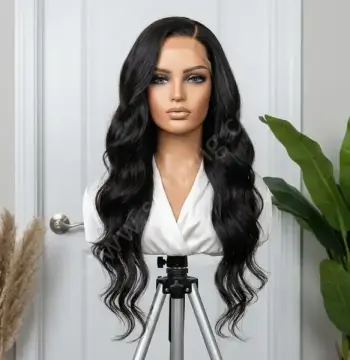
24" Body Wave HD Lace Front Human Hair Wig Rich Black with Bangs Pre-Plucked for Special Occasions
- Lengths
- 12" · 14" · 16" · 18" · 20" · 22" · 24"
- Lace
- 13x4 Lace · 13x6 Lace
- Cap
- Small · Medium · Large

HD Lace Front Human Hair Wig Warm Brown Wave Balayage Pre-Plucked Natural Hairline Brazilian Hair
- Lengths
- 12" · 14" · 16" · 18" · 20" · 22" · 24"
- Lace
- 13x4 Lace · 13x6 Lace
- Cap
- Small · Medium · Large

HD Lace Front Human Hair Wig Dark Brown Wave Highlights Pre-Plucked Natural Hairline Brazilian Hair
- Lengths
- 12" · 14" · 16" · 18" · 20" · 22" · 24"
- Lace
- 13x4 Lace · 13x6 Lace
- Cap
- Small · Medium · Large