Human hair or synthetic?
Synthetic arrives with a set style and needs little work between washes, but offers limited scope for change. Human hair needs restyling after washing and can be cut, darkened and heat-styled. Choose according to the maintenance and flexibility you want; neither material is universally better.
| Dimension | Human hair | Synthetic |
|---|---|---|
| Out of the box | Needs styling — it arrives as hair, not as a hairstyle | Arrives styled and returns to that style after every wash |
| Daily effort | Brush, occasional heat, occasional product | Shake it out and wear it |
| Can it be changed? | Cut, layered, coloured darker, heat-styled — like your own hair | No. The style and colour it arrives with are permanent |
| Heat tolerance | Yes, with a protectant at moderate temperatures | Only if sold as heat-friendly, and then within strict limits |
| How it looks close up | Moves and reflects light irregularly, which is what reads as real | More uniform, and shinier under direct or flash light |
| Comfort over a long day | Breathes better, noticeably cooler at hour eight | Lighter on the cap, but warmer against the scalp |
| Typical life in daily wear | Several months to about a year, and responds to careful handling | Weeks to a few months, and handling makes less difference |
| Price | Several times the price of a comparable synthetic | The cheapest way into wearing a wig |
Pick Human hair if
You'll be wearing it most days, you want it to look like hair rather than like a hairstyle, or you want the option to have it cut and fitted to you. It's also the more forgiving material to learn on — it recovers from mistakes that ruin synthetic fibre permanently.
Pick Synthetic if
You want a specific look with no effort, you're wearing it occasionally rather than daily, or you're finding out whether wigs suit you at all before spending properly. It's also the sensible choice for a style you'd struggle to maintain yourself, like a set curl.
Start with the routine you want
The material choice isn’t a quality decision, which is how it’s usually framed. It’s a decision about who does the styling.
A synthetic wig arrives as a finished hairstyle. The curl or the fall was set into the fibre at the factory using heat that the fibre remembers permanently. Wash it, let it dry, and it returns to that same shape without you doing anything. That’s the entire appeal, and for a lot of people it’s the correct answer.
A human hair wig arrives as hair. Which means it arrives with no opinion about how it should look, and after every wash you’re responsible for putting the style back. In exchange you can cut it, layer it, add a fringe, heat it, darken the colour, and generally treat it as your own.
So the useful question is: do you want a hairstyle that maintains itself, or hair you can do things to?
Everything else in the comparison follows from that.
Cost per month, not cost per wig
The price gap is large enough that it deserves proper arithmetic rather than a shrug.
A human hair lace front costs several times what a comparable synthetic does. Under occasional wear — a few times a month — the synthetic is straightforwardly the better financial decision, and it isn’t close. A synthetic wig worn twice a week will keep looking respectable for a long time.
Under daily wear the numbers move. Synthetic fibre degrades from friction rather than from age: the nape frizzes where it rubs on collars, and once fibre is frizzed it cannot be repaired, only cut off. A synthetic wig worn every day is often finished within a couple of months, and no amount of care extends it much.
Human hair responds to care. Wash it gently, keep it off collars, condition the ends, and the same wig lasts several months to a year in daily wear. Two human hair wigs alternated last considerably longer than that.
Which is why people who wear wigs daily tend to migrate to human hair even when they started out reluctant about the price, while occasional wearers happily stay synthetic for years. Both are behaving rationally.
Which forgives being learned on
An underrated point in favour of human hair, particularly for a first wig.
New wig owners make mistakes. They wash it too often, brush it dry, use hot water, put a straightener on it, apply too much product. Human hair mostly recovers from all of that — a bad month leaves it dry and it comes back with conditioning and a trim.
Synthetic fibre doesn’t recover. Excess heat is permanent, brushing frizz into it is permanent, and a wrongly applied product that coats the fibre often can’t be washed out. The consequence of learning on synthetic is a wig you can’t fix.
Include replacement risk in the price comparison. A cheaper practice wig stops being economical if an early mistake makes it unusable.
Where synthetic genuinely wins
Not a consolation-prize list — these are real advantages.
Set styles. If you want a specific defined curl, a sharp bob, or a bouncy shape, synthetic holds it permanently and human hair needs re-setting every wash. For a strongly styled look, synthetic is arguably the better material, not the compromise.
Weight. Synthetic fibre is lighter than human hair. On a long wig at high density that’s a genuine comfort difference at the cap, even though the material breathes less.
Colour range. Anything vivid, pastel, or precisely graduated is easier and cheaper in synthetic, because it’s coloured as fibre rather than dyed as hair.
Low-effort mornings. A synthetic style that returns to its set shape after washing can be useful when time or energy is limited. That convenience is a valid reason to own one alongside a human hair wig.
What we sell, and why we’re telling you
Every wig we recommend is human hair. That’s a real bias in this comparison and you should read the page knowing it.
The reason isn’t that synthetic is inferior. It’s that our sister shop is set up for daily wearers, and human hair is what suits daily wear — it lasts, it can be fitted to a person by a stylist, and it survives being learned on. That’s the customer we’re built for.
If you’ve read the above and concluded that synthetic fits how you’d actually use a wig, then buy synthetic. We’d rather say that than talk you into the more expensive material for a use case it doesn’t suit. There isn’t a version of this comparison where one material wins outright.
If you choose human hair, read the material claim carefully without treating every quality term as a guarantee. Our guide to Remy, virgin, double drawn and origin labels separates useful specifications from trade shorthand.
Questions people ask
Which one looks more realistic?
Human hair, mostly because of how it behaves rather than how it looks in a still photograph. It moves irregularly, catches light unevenly and sits at slightly different lengths — all of which the eye reads as real. Good synthetic is very convincing in a photograph and less so in motion.
Is synthetic hair bad for you?
No. It's a plastic fibre, and a small number of people react to the coating on new synthetic hair, which usually washes out. What it isn't is breathable, so it runs warmer against the scalp over a long day.
Can I dye a synthetic wig?
Not with ordinary hair colour, which has nothing to bind to. Specialist fabric or alcohol-based inks exist and results are unpredictable. Treat the colour as fixed when you buy it.
Which is cheaper over a year?
It depends entirely on how often you wear it. For occasional wear, synthetic is unambiguously cheaper. For daily wear, the arithmetic often favours human hair, because a synthetic wig worn every day is measured in weeks rather than months.
What about a blend?
Blends exist and behave roughly like the synthetic component under heat, so treat them with synthetic's caution rather than human hair's freedom. They're a middle option, not the best of both.
From the catalogue
Where most people start
This page doesn't narrow the catalogue, so these are simply well-reviewed lace fronts rather than a match to anything above.
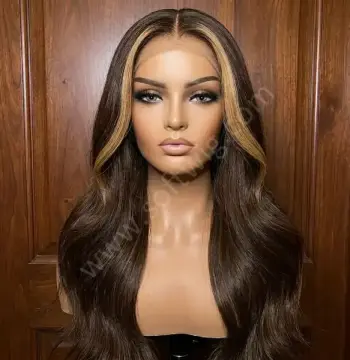
Flowing Long Wave Honey Blonde Highlights on Brown HD Lace Front Human Hair Wig 20" Density 180% Full
- Lengths
- 12" · 14" · 16" · 18" · 20" · 22" · 24"
- Lace
- 13x4 Lace · 13x6 Lace
- Cap
- Small · Medium · Large

16" Bouncy Body Wave HD Lace Front Human Hair Wig Soft Blonde Highlights over Brown for Black Women
- Lengths
- 12" · 14" · 16" · 18" · 20" · 22" · 24"
- Lace
- 13x4 Lace · 13x6 Lace
- Cap
- Small · Medium · Large

Effortless Wave Copper Orange Ombre HD Lace Front Human Hair Wig 18" Luxe Brazilian
- Lengths
- 12" · 14" · 16" · 18" · 20" · 22" · 24"
- Lace
- 13x4 Lace · 13x6 Lace
- Cap
- Small · Medium · Large

HD Lace Front Human Hair Wig Deep Chocolate Brown Body Wave Middle Part Pre-Plucked Natural Hairline Brazilian Hair
- Lengths
- 12" · 14" · 16" · 18" · 20" · 22" · 24"
- Lace
- 13x4 Lace · 13x6 Lace
- Cap
- Small · Medium · Large