How long a wig should last, and what decides it
Count wearings, not calendar months. Our planning range for a human hair lace front is about 150 to 300 good wearings. That is an editorial rule of thumb, not a tested industry figure. Friction at the nape and repeated handling of the lace usually determine when it needs replacing.
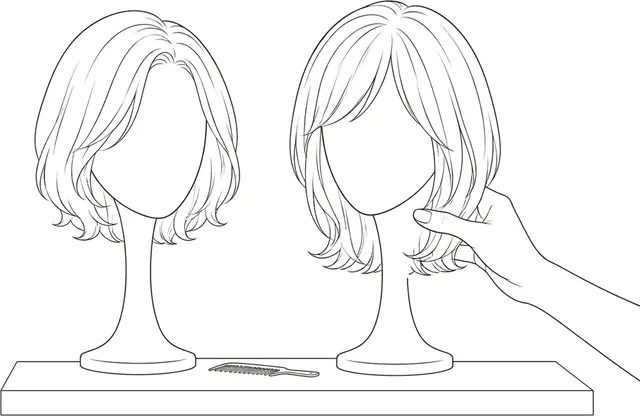
Count wearings, not months
“How long does a wig last” has no useful answer in months, because a wig worn daily and a wig worn twice a month age at completely different rates and calendar time barely features in either.
As a planning figure, we work on a human hair lace front having somewhere in the region of 150 to 300 good wearings in it. Be clear about where that number comes from: it’s our own rule of thumb from what people describe to us, not a measured figure from a study, and nobody tests wigs this way. Treat it as a way to think about the purchase rather than a specification. It converts roughly as follows:
| How often you wear it | Roughly how long it looks good |
|---|---|
| Every day | Six months to a year |
| Weekdays only, with weekends off | Eight months to fifteen months |
| Two wigs alternated daily | Well over a year each |
| A couple of times a week | Two to three years |
| Occasional wear only | Several years |
“Looks good” is doing some work there. A wig doesn’t stop functioning — it gradually stops looking like new hair, and where you place that line is a matter of taste. Some people replace at the first hint of dryness; others wear a wig for another six months past the point we’d have retired it.
What runs out first
Three components, and they fail in a predictable order. Knowing which one is ahead of the others tells you what to spend your care effort on.
The nape. Almost always first, and it’s friction rather than age. The hair at the back of your neck spends every day rubbing against coat collars, scarves, seatbelts, car seats and, if you sleep in it, pillows. Friction is what mats hair, and matting is what ends wigs. This is why length matters more to wear life than price does — hair that sits above the collar simply doesn’t get this treatment.
The lace. Second, and it’s handling. Every time a wig goes on or off, the front edge is touched. Do that daily for a year and the mesh softens, then thins, then tears. Adhesive and its removal accelerate this considerably, which is the strongest practical argument for glueless caps on a wig you wear most days.
The ends. Last, and gradually. Ends are the oldest hair on the wig and the furthest from anything that could condition them, and they go dry before they go wispy. This is the failure that’s actually reversible: a trim removes the dry inch and the wig looks intentional again.
Notice that none of these are the hair in the middle of the wig, which is usually in decent condition long after the wig has been retired.
The four habits that move the number
If you want the same wig to last twice as long, these are the levers, in order of effect.
Get it off your collar. Lift the hair out from under a coat collar the way you would with your own hair. This one habit addresses the primary cause of the primary failure, and it costs nothing.
Wash less often. Washing is the most damaging routine event in a wig’s life. Every ten to fifteen wearings is a sensible interval for daily use — and if the hair still looks and smells fine, stretch it further. There’s no benefit to washing hair that isn’t dirty.
Don’t sleep in it. A night against a pillow does roughly what a day under a collar does. It’s the single largest avoidable source of wear.
Handle the cap, not the hairline. Pick the wig up by the cap. Put it on by placing the cap and then positioning the front, rather than by pulling at the lace edge.
Once the basics are covered, store the wig on a stand between regular wears and trim dry ends before they distort the shape.
Where money makes a difference, and where it doesn’t
Better hair holds up better to washing. That effect is real: higher-grade human hair keeps its cuticle intact for longer, so it stays smooth after more wash cycles and tolerates heat better. So price does buy some wear life.
What price does not buy is resistance to friction. A $500 wig worn under a wool collar every day will mat at the nape on roughly the same schedule as a $200 one. Nor does it buy lace durability in any meaningful way — fine lace is fine lace. What the money does buy, band by band, is set out separately.
Which is why the useful mental model is that care sets the range and price moves you within it. A careful owner with a mid-priced wig comfortably outlasts a careless owner with an expensive one, and that gap is larger than any gap between price tiers.
How rotation changes wear life
If you’re planning for daily wear, this is worth knowing before you spend everything on one wig.
Two wigs alternated don’t just split the wearings — they also each get a full day to dry out and recover between wears, which prevents the damp-fibre matting that does most of the damage at the nape. The result is that two wigs tend to last longer in total than the same money spent on one better one.
The gain is not unlimited, but for daily wear it can make two good wigs a more durable purchase than a single premium wig at the same total cost.
What’s not normal
For completeness, because expectation-setting cuts both ways: a wig that’s matted, shedding heavily or looking worn out within a few weeks is not following the pattern above.
Rapid deterioration has a separate cause, such as the hair itself, factory processing or a specific care problem. The link below goes to a diagnostic guide on our sister site.
What to look for on a listing
- Material
- Human hair, which responds to care in a way synthetic doesn't
- Length
- Above collar length lasts longest, because the nape is what wears
- Attachment
- Glueless, to keep the wear off the lace
Questions people ask
How long does a human hair wig last?
In daily wear, roughly six months to a year before it looks tired — and considerably longer with two wigs alternated, or with occasional wear. The useful measure is wearings rather than calendar time: a wig worn twice a week can look good for years.
What makes a wig wear out?
Friction and handling, in that order. Friction at the nape from collars and seatbelts is what mats hair, and handling at the front edge every time it goes on and off is what finishes the lace. Neither is about the quality of the hair.
Does an expensive wig last longer?
Better hair holds up better to washing, so there's a real effect — but it's smaller than the effect of how you handle it. A careful owner with a mid-priced wig will comfortably outlast a rough owner with an expensive one.
Can a worn-out wig be revived?
Partly. A trim removes dry ends and buys months. A deep conditioning treatment restores some softness. What can't be fixed is matted hair at the nape or a torn hairline — both are cut out or lived with.
When is it time to replace one?
When the nape mats faster than you can detangle it, when the lace tears at the front, or when the ends have been trimmed back so far that the shape no longer works. Usually one of those arrives clearly rather than gradually.
From the catalogue
Where most people start
This page doesn't narrow the catalogue, so these are simply well-reviewed lace fronts rather than a match to anything above.

HD Lace Front Human Hair Wig Warm Brown Wave Balayage Pre-Plucked Natural Hairline Brazilian Hair
- Lengths
- 12" · 14" · 16" · 18" · 20" · 22" · 24"
- Lace
- 13x4 Lace · 13x6 Lace
- Cap
- Small · Medium · Large

HD Lace Front Human Hair Wig Honey-Bronze Wave Highlights Pre-Plucked Natural Hairline Brazilian Hair
- Lengths
- 12" · 14" · 16" · 18" · 20" · 22" · 24"
- Lace
- 13x4 Lace · 13x6 Lace
- Cap
- Small · Medium · Large

HD Lace Front Human Hair Wig Money Piece Highlights Straight Money Piece Pre-Plucked Natural Hairline Brazilian Hair
- Lengths
- 12" · 14" · 16" · 18" · 20" · 22" · 24"
- Lace
- 13x4 Lace · 13x6 Lace
- Cap
- Small · Medium · Large

Premium Brown Silk Straight HD Lace Front Human Hair Wig 20" Glueless Cap
- Lengths
- 12" · 14" · 16" · 18" · 20" · 22" · 24"
- Lace
- 13x4 Lace · 13x6 Lace
- Cap
- Small · Medium · Large