How a glueless wig stays in place
A glueless wig is held by a correctly sized cap, two adjustable straps and two or three small combs, and for ordinary daily wear that's genuinely enough. What it won't do is survive high wind or someone tugging at it, and that's the whole trade-off.
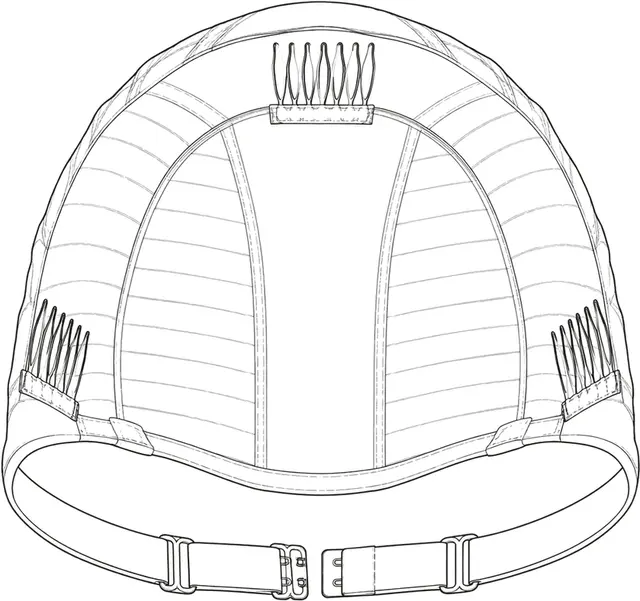
How the cap, straps and combs share the hold
Take a glueless wig and turn it inside out. There are only three mechanisms in there, and they work together.
The cap itself. This does most of the work, and it’s the part people overlook while worrying about the other two. A cap in your measured size grips through simple tension — the stretch material holds a slight compression against your head all the way round. A cap that’s too large has nothing to grip with, and no amount of strap adjustment or combs compensates for it. If you take one thing from this page: hold is a sizing problem before it’s an attachment problem.
Two adjustable straps at the nape. Usually hook-and-eye or a slider, sitting inside the back of the cap. These fine-tune the circumference by an inch or so. They’re for adjustment, not for security — a wig held on by tight straps is uncomfortable and pulls on your own hairline.
Combs. Small wire teeth sewn into the lining, typically one at the front, one at each side, and one at the nape. They bite into your own hair and stop the wig sliding backwards. On a bare scalp they have nothing to grip, which is why a wig cap liner or a band is often recommended in that case.
That’s it. There’s no clever technology, and there doesn’t need to be.
Where a glueless fit stays secure
Ordinary daily wear: entirely secure. Walking, working, driving, shopping, eating, talking, bending down to pick something up. A properly sized glueless wig does not move in any of those, and most people stop thinking about it within a week.
Where it can shift:
Wind at the front edge. The most common complaint. Combs prevent backward slide; nothing prevents a gust lifting the front. In genuinely windy weather, tying the hair back or wearing a hat is the practical answer.
Leaning back hard. A headrest, a shampoo basin, a dentist’s chair. Pressure at the nape can nudge the wig forward slightly.
Vigorous exercise. Running especially. Repeated impact plus perspiration loosening the cap’s grip is the situation glueless handles worst.
Someone pulling it. Worth naming plainly, because people worry about it. A glueless wig will come off if it’s yanked — small children, an enthusiastic hug, a hairbrush caught in it. Glue resists that considerably better.
If none of those describe your week, you don’t need adhesive.
Setting it up once, properly
Most glueless complaints trace back to setup rather than to the wig, and the setup is a ten-minute job you do once.
Measure your head first, around the hairline, above the ears and around the nape. Buy that size rather than assuming medium.
Adjust the straps with the wig on, not in your hands. Put it on, position the front edge at your hairline, then take the straps in a little at a time until the wig sits still when you shake your head. Stop there.
Check the combs are engaging hair, not scalp. Slide them in at a shallow angle, into hair rather than against skin. A comb pressing on scalp is the source of a lot of “wigs hurt” complaints.
Wear it for an hour before you commit. Discomfort from over-tightening arrives at around the forty-minute mark, not immediately, which is why people set them too tight in the shop mirror and regret it later.
Once set, leave them. Daily re-adjustment is unnecessary and it’s how the mechanism wears out.
The rest of that first fitting — what goes underneath, where exactly the front edge sits, and when to stop fiddling with it — is set out step by step in how to put a wig on.
Where a band helps and what it costs
A silicone or velvet grip band sits around the perimeter of your head, under the wig, adding friction where the cap edge sits.
It genuinely works. If your own hair is fine and slippery, if you’re on your feet all day, or if there’s no hair under the cap for the combs to grip, a band converts an adequate hold into a completely stable one.
The cost is that all the added grip is concentrated in a narrow strip, and that strip doesn’t move for as long as you’re wearing it. On most people that’s unremarkable. On a sensitive or bare scalp it produces a warm, itchy line along the hairline that’s frequently mistaken for a reaction to the wig itself.
So: try without one first. Add it if you need it. And if you’ve got a wig you find itchy, take the band out before you conclude anything about the wig.
Glueless versus glue, in one paragraph
Adhesive buys you a front edge that disappears completely and hold that survives wind, sport and being touched. It costs you application time every wear, removal time every night, a risk of irritation, and the main cause of lace damage at the hairline.
Glueless buys you a wig you can put on in two minutes without a mirror, take off in one, and wear on a reactive scalp. It costs you a front edge that’s very good rather than invisible, and a hold that’s reliable rather than absolute.
For daily wear, most people who try both end up glueless. For a wedding, a photoshoot, or anything where the wig has to be perfect for one long day, glue earns its place — applied by someone who has done it before.
Where professional fitting can help
Not the band, not the adhesive, not the lace. The cap size.
A wig in the right size, with the straps set once and the combs seated properly, is stable enough that everything above becomes a footnote. A wig in the wrong size can’t be rescued by any of it — too large slides no matter what you add, too small gives you a headache by lunchtime and pushes the front edge back off your hairline.
Measure first. It’s five minutes and it decides more than any other choice on the page.
What to look for on a listing
- Density
- 180% as standard, and a heavier wig needs a better-fitting cap
- Length
- Shorter wigs pull less on the cap and stay put more easily
- Cap
- Measured size — this is what does most of the holding
- Attachment
- Adjustable straps plus combs, and nothing else
Questions people ask
Will a glueless wig fall off?
Not in ordinary use, if the cap is the right size and the straps are set. It can shift — most commonly at the front edge in wind, or if you lie back on a headrest. Falling off entirely is rare and usually means the cap is too large.
How tight should the straps be?
Snug enough that the wig doesn't move when you shake your head, loose enough that you can't feel pressure anywhere after an hour. If you can feel it, it's too tight, and too tight is worse than slightly loose — it causes headaches and tension on your own hairline.
Do I need a grip band?
Most people don't. A correctly sized cap holds well on its own, and a band adds constant friction along a narrow strip of scalp. If you're active, have very fine slippery hair, or wear a wig on a bare scalp, a band can help — but try without first.
Can I exercise in a glueless wig?
For anything moderate, yes. For running, swimming or contact sport, no — the combination of movement and moisture is what glueless attachment handles worst. A band helps, and an elasticated sports cap underneath helps more.
Is glueless bad for a lace front?
It's better for the lace than glue is. Adhesive and its removal are the main cause of lace damage at the hairline, so a wig that goes on and off without either lasts longer at the front.
From the catalogue
Where most people start
This page doesn't narrow the catalogue, so these are simply well-reviewed lace fronts rather than a match to anything above.

HD Lace Front Human Hair Wig Honey Brown Wave Balayage Pre-Plucked Natural Hairline Brazilian Hair
- Lengths
- 12" · 14" · 16" · 18" · 20" · 22" · 24"
- Lace
- 13x4 Lace · 13x6 Lace
- Cap
- Small · Medium · Large

HD Lace Front Human Hair Wig Black-Red Ombre Wave Ombre Pre-Plucked Natural Hairline Brazilian Hair
- Lengths
- 12" · 14" · 16" · 18" · 20" · 22" · 24"
- Lace
- 13x4 Lace · 13x6 Lace
- Cap
- Small · Medium · Large

HD Lace Front Human Hair Wig Warm Brown Wave Balayage Pre-Plucked Natural Hairline Brazilian Hair
- Lengths
- 12" · 14" · 16" · 18" · 20" · 22" · 24"
- Lace
- 13x4 Lace · 13x6 Lace
- Cap
- Small · Medium · Large

HD Lace Front Human Hair Wig Jet Black Loose Wave Pre-Plucked Natural Hairline Brazilian Hair
- Lengths
- 12" · 14" · 16" · 18" · 20" · 22" · 24"
- Lace
- 13x4 Lace · 13x6 Lace
- Cap
- Small · Medium · Large