Bleached knots and pre-plucked hairlines
Both phrases describe work done at the factory to make a hairline look less uniform. Pre-plucked means hair has been removed to soften the density at the front; bleached knots means the dark dots where each strand is tied have been lightened. Heavily bleached knots look better on day one and weaken the lace, which is why lightly bleached is the more sensible buy.
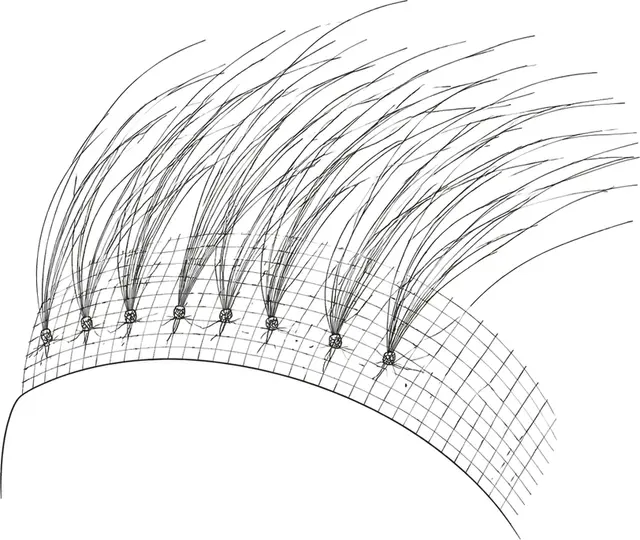
Two phrases, one problem
A lace front wig is made by tying individual strands of hair, by hand, to a fine mesh. That construction is what allows the hairline to look like hair emerging from skin instead of from a seam.
It also creates two small problems, and the phrases in every listing are the factory’s answers to them.
Each tie leaves a knot. Under close inspection, an untreated lace front has a field of tiny dark dots across the mesh — one per strand. At conversational distance they read as a slightly grey shadow along the hairline. Bleached knots means those dots have been chemically lightened.
Real hairlines aren’t uniform. Your own hairline is irregular: denser in some places, finer at the temples, with stray shorter hairs in front. A factory hairline is even, because it’s made to a pattern. Pre-plucked means hair has been removed from the front to break up that regularity.
Both treatments can improve a factory hairline, and both can weaken it when pushed too far. Separate them from terms such as Remy, virgin and double drawn, which describe the hair itself and are explained in this guide.
Bleached knots, and what the bleach costs
Bleaching is done from the underside of the lace, on the knots only. Done properly, the dark tie becomes near-invisible against the mesh, and the hairline gains several points of realism for no visible cost.
The cost isn’t visible, which is exactly the problem. Bleach weakens two things: the lace fibre it sits on, and the base of each strand where the knot is tied. A heavily bleached hairline is more convincing on day one and more fragile for the whole of the wig’s life. It’s the single most common origin of shedding specifically at the front — not poor construction, but chemistry.
This is why lightly bleached is the sensible specification, and it’s what the wigs we recommend are: lightly bleached or unbleached, on hand-tied Swiss lace. A light bleach removes most of the visual problem while leaving the lace with its strength. Unbleached knots are the most durable option of all, and if you use any foundation or tinting product along the hairline, the knots disappear under it anyway.
The listings that boast about how thoroughly the knots have been bleached are advertising the version that photographs best, which is not the version that lasts.
Pre-plucked, and why it can’t be undone
Pre-plucking is straightforward in principle: remove some density at the front edge so the hairline fades in rather than starting abruptly.
Well done, it’s the difference between a wig that reads as hair and one that reads as a wig, and it’s the reason a good proportion of listings mention it — around half of the wigs in our own catalogue say so in the title.
Badly done, it produces a front that looks thin and receding, and there is no remedy. Hair can be removed from lace; it cannot be added back without re-ventilating the wig by hand, which is specialist work costing a significant fraction of a new wig.
So the asymmetry matters: a slightly too-dense hairline is a five-minute fix with tweezers. A too-sparse one is permanent. If you’re choosing between two wigs and one is described as heavily pre-plucked, the conservative option is the better bet.
If you want to adjust it yourself
Plenty of people do, and on a hairline that’s genuinely too dense for their face it’s the right call. The technique matters less than the restraint.
Work with the wig on a stand, in good light, with tweezers rather than scissors. Take hairs from the very front edge only, one or two at a time, and pull in the direction the hair grows rather than straight up. Stop every ten or fifteen hairs, step back, and look at it from arm’s length rather than from six inches — the distance at which you’ll be seen is the distance that matters.
Two mistakes account for nearly all the damage we hear about. Plucking too far back from the edge, which thins the area behind the hairline rather than softening the line itself. And continuing past the point where it looks right, because at close range it never looks quite irregular enough.
The rule that saves wigs: stop earlier than you want to, wear it for a day, and come back to it if it still needs work.
The details that make a hairline convincing
Knots and plucking are two of three factors, and the third is free.
Position. A wig sitting even half an inch too far back changes the proportions of a forehead in a way people notice immediately, without being able to say why. This is the most common reason a good wig looks wrong, and it costs nothing to correct — the front edge belongs where your own hairline is, which for most people is roughly four fingers above the eyebrows.
Get the position right and a lightly bleached, lightly plucked hairline is entirely convincing. Get it wrong and no amount of factory work at the front will save it.
Which is a reasonable summary of the whole subject: buy the conservative version of both treatments, put it where your hair starts, and leave the rest alone.
What to look for on a listing
- Material
- Human hair, so the front can be adjusted further by a stylist if needed
- Cap
- Hand-tied Swiss lace front, lightly bleached or unbleached knots
- Attachment
- Glueless is fine — the hairline work matters more than the adhesive
Questions people ask
What is a knot on a wig?
Each strand of hair on a lace front is tied individually to the mesh by hand, and that tie is a knot. On close inspection the knots look like tiny dark dots across the lace, which is what gives away an untreated hairline.
What does bleaching the knots do?
It lightens those dots so they read as scalp rather than as dark specks. Done lightly, it makes the hairline considerably more convincing. Done heavily, it also weakens the lace and the base of each strand, which is where shedding at the front begins.
Is pre-plucked always better?
No. Pre-plucked means density has been removed at the front to imitate the way a natural hairline thins out. Lightly done, it's exactly right. Overdone, the front looks sparse and receding, and you cannot put hair back — this is the one adjustment that only goes in one direction.
Should I pluck it further myself?
Only if it genuinely looks too dense on you, and then a few hairs at a time with tweezers, from the very front edge, checking in a mirror at arm's length. It's irreversible, so the instruction that matters is to stop earlier than you think.
Can I bleach the knots myself?
You can, and we'd suggest not. It involves bleach against fine lace, the margin between lightened and damaged is narrow, and a mistake takes the hairline off the wig. If a wig arrives with unbleached knots and it bothers you, a stylist who works on wigs is the safer route.
From the catalogue
Where most people start
This page doesn't narrow the catalogue, so these are simply well-reviewed lace fronts rather than a match to anything above.

HD Lace Front Human Hair Wig Warm Brown Wave Middle Part Pre-Plucked Natural Hairline Brazilian Hair
- Lengths
- 12" · 14" · 16" · 18" · 20" · 22" · 24"
- Lace
- 13x4 Lace · 13x6 Lace
- Cap
- Small · Medium · Large

Pre-Plucked Gradient Ombre Dark Brown Loose Body Wave HD Lace Front Wig for Casual Outings
- Lengths
- 12" · 14" · 16" · 18" · 20" · 22" · 24"
- Lace
- 13x4 Lace · 13x6 Lace
- Cap
- Small · Medium · Large
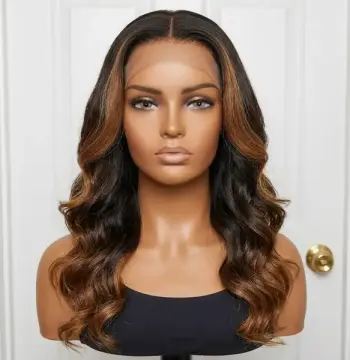
16" Chocolate Brown Ombre Body Wave HD Lace Front Human Hair Wig Pre-Plucked
- Lengths
- 12" · 14" · 16" · 18" · 20" · 22" · 24"
- Lace
- 13x4 Lace · 13x6 Lace
- Cap
- Small · Medium · Large

Caramel Ombre Brown Soft Body Wave HD Lace Front Human Hair Wig 13x4 HD Lace for Office Look
- Lengths
- 12" · 14" · 16" · 18" · 20" · 22" · 24"
- Lace
- 13x4 Lace · 13x6 Lace
- Cap
- Small · Medium · Large