Heat style a human hair wig with less damage
Confirm the fibre and maker's heat limit, work only on fully dry hair, apply a compatible heat protectant and test a hidden strand. Start at the lowest effective setting, use controlled passes, and keep hot tools away from lace, knots and cap materials.
Human hair accepts heat styling, but that does not give every wig the same heat tolerance. Colouring, factory processing, previous heat and ordinary wear all change how much stress the strands can take. The cap contains different materials again.
A good result uses the minimum heat and contact needed for the shape, while keeping the tool clear of lace and knots.
Confirm what you have
Read the fibre label and the manufacturer’s care instructions before plugging in a tool. Check for a stated maximum, prohibited tool types and directions for heat protectant. If the wig has mixed fibres, extensions, decorative strands or an unknown history, do not assume a human hair description applies to every part.
Inspect the condition in daylight. Split ends, a rough patch, faded colour or short broken hairs indicate a section that needs less stress. Heat will not repair dryness; it can make damaged hair look smoother briefly while weakening it further.
If the wig is new and you have not decided to keep it, do not style it. Heat and products can alter its condition and affect a return. Start with the arrival inspection first.
Prepare hair and tools
The wig must be clean enough that oils and styling residue will not bake onto the strands, and fully dry before an iron or curling tool touches it. Wash it gently if product build-up is present, then allow the cap and roots to dry completely.
Detangle in sections from the ends upward. A hot tool should never be used to press through a knot. The detangling method keeps that tension away from the lace.
Secure the wig to a stable heat-resistant stand through reinforced cap material. Keep pins out of the lace. Clean the tool plates or barrel so old product cannot transfer, and check that the temperature control responds normally.
Apply a light, even layer of heat protectant approved for human hair wigs or processed human hair. More is not more protective; saturation can make the tool drag and leave residue.
Test a hidden strand
Choose a narrow section underneath at the back. It should be hidden during normal wear but representative of the hair you plan to style.
Set the tool low and allow it to stabilise. Make one controlled pass or hold the curl only for the time needed to shape it. Let the strand cool, then check:
- Did it take the intended shape?
- Does it feel rougher, stiff or sticky?
- Has the colour shifted?
- Is there an unusual smell, smoke or visible residue?
- Does it comb as easily as before?
Stop immediately if the strand scorches, shrinks, discolours or changes texture. If it remains sound but the shape does not hold, increase the setting in a small step without exceeding the maker’s limit, then retest on a fresh hidden section.
The lowest setting that produces the result is your working setting for that session. It is not a permanent number; the hair’s condition changes with wear and chemical processing.
Straightening
Divide the dry hair into narrow sections. Hold each section under light tension below the tool so the plates move smoothly, then make a steady pass from below the knotted area toward the ends.
Do not clamp onto the lace or press an iron against the cap to flatten the roots. Lace, elastic, thread, combs and clips may have lower heat tolerance than the hair. For flyaways near the base, use indirect tool placement and a comb to guide the hair without touching the construction.
Repeated fast passes concentrate heat without improving control. A smaller section and one deliberate pass usually produce a cleaner result.
Curling
Use sections sized for the curl you want and keep the barrel away from the base. After releasing each curl, support it in your hand or clip it loosely until cool. Hair sets as it cools; pulling it straight while warm wastes the heat already applied and encourages another pass.
Change direction deliberately around the face and part instead of reheating finished sections in search of symmetry. Brush or separate curls only after the whole wig has cooled.
Limit repeat exposure
Daily touch-ups repeatedly heat the same visible strands at the part and around the face. Preserve the result between wears on a stand, use pin curls or rollers where appropriate, and protect the shape during storage instead of recreating it every morning.
Chemical services narrow the margin further. If the wig has been lightened, coloured or is due for colour work, coordinate heat and chemical processing instead of stacking them close together. The wig dye guide explains why previously processed hair responds differently.
For buyers deciding between fibres, human hair and synthetic wigs offer different styling trade-offs. Heat-friendly synthetic still follows its own stated limit; this human hair method does not override it.
Questions people ask
What temperature should I use on a human hair wig?
There is no dependable universal setting. Processing history, colour, strand condition, tool calibration and the maker's instructions all matter. Begin below the stated maximum, test a hidden strand and raise the setting only if the result requires it.
Does human hair mean any heat tool is safe?
No. Human hair can still be heavily processed, coloured or already weakened. The hair may tolerate a setting that damages lace, elastic or clips, so tool placement matters as much as the temperature shown on the dial.
Can I heat style a damp wig?
Use irons and curling tools only on fully dry hair unless a specific tool and product are designed for another method. Applying an ordinary iron to damp hair can produce uneven damage, and damp roots make it harder to keep heat away from the cap.
Can I use this method on a synthetic wig?
Only if the wig is explicitly labelled heat-friendly, and only within the manufacturer's stated limit. Ordinary synthetic fibre can deform or melt. A human hair label should never be inferred from appearance alone.
From the catalogue
Where most people start
This page doesn't narrow the catalogue, so these are simply well-reviewed lace fronts rather than a match to anything above.
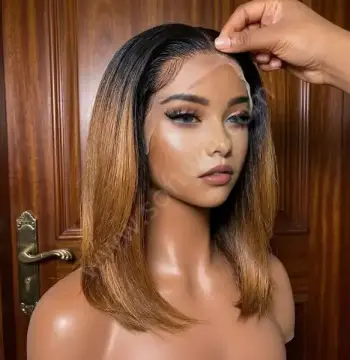
Silky Straight Ombre Medium Brown HD Lace Front Human Hair Wig 14" Short Bob Glueless
- Lengths
- 10" · 12" · 14" · 16"
- Lace
- 13x4 Lace · 13x6 Lace
- Cap
- Small · Medium · Large

22" Long Wave HD Lace Front Human Hair Wig Rich Black Density 180% Full for Office Look
- Lengths
- 12" · 14" · 16" · 18" · 20" · 22" · 24"
- Lace
- 13x4 Lace · 13x6 Lace
- Cap
- Small · Medium · Large

HD Lace Front Human Hair Wig Natural Deep Brown Body Wave Middle Part Pre-Plucked Natural Hairline Brazilian Hair
- Lengths
- 12" · 14" · 16" · 18" · 20" · 22" · 24"
- Lace
- 13x4 Lace · 13x6 Lace
- Cap
- Small · Medium · Large
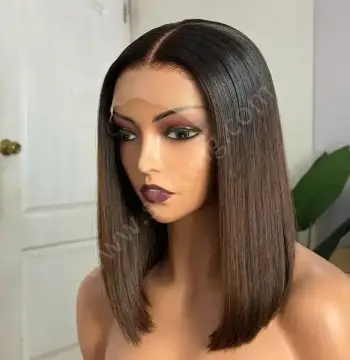
Gradient Ombre Brown Silky Straight HD Lace Front Human Hair Wig Short Bob for Bridal Hairstyles
- Lengths
- 10" · 12" · 14" · 16"
- Lace
- 13x4 Lace · 13x6 Lace
- Cap
- Small · Medium · Large