How to wash a wig without wrecking it
Wash less often than you think, always downward, and never in a basin of water you've swirled it around in. Most wigs that go dry and tangled within months were washed too often and too roughly, not made badly.
Wash less than you think
The most useful thing in this entire guide: most wigs are washed too often.
Your own hair needs washing partly because your scalp produces oil. A wig doesn’t have a scalp. What it accumulates is product, environmental grime, and whatever transfers from your skin — which is a much slower process than natural oil production.
Every wash costs a little. Water swells the hair shaft, handling creates friction, and unlike hair growing out of your head, none of it is being replaced.
As a starting point:
- Daily wear — somewhere around every 10 to 15 wears
- A few times a week — every few weeks
- Occasional wear — when it actually needs it, not on a schedule
Use the interval as a starting point, then judge the wig by smell, product build-up and movement. Clean, soft hair does not need an unnecessary wash simply because a date has passed.
The basin mistake
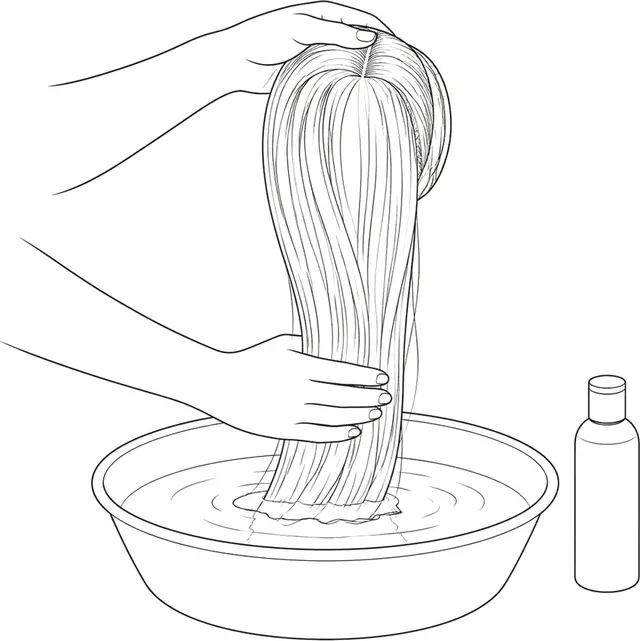
Here’s the specific action that causes more matting than anything else in a washing routine: filling a basin, putting the wig in, and moving it around in the water.
It seems gentle. It isn’t. Hair suspended in water and agitated tangles against itself in every direction at once, and the mat that forms is compressed and difficult to get out. You then have to brush it out wet, which is when hair is most vulnerable, and the whole thing compounds.
Everything in a wig wash should move in one direction: down.
The routine
Detangle first, dry. Before any water touches it, brush the wig out completely with a wide-tooth comb or a wig brush, starting at the ends and working up. Any tangle that goes into the water comes out worse.
Rinse downward. Hold the wig under running water — lukewarm, not hot — with the water flowing from the cap toward the ends. Let it run through. Don’t bunch it up.
Shampoo the cap area, not the length. The base is where product and skin contact accumulate. Work a small amount of gentle shampoo through the cap with your fingertips, then let the suds run down through the length as you rinse. The length rarely needs direct scrubbing.
Condition the length, not the cap. The opposite distribution. Conditioner belongs on the mid-lengths and ends, where the hair is oldest and driest. Keep it off the base — conditioner at the knots loosens them over time, and loose knots mean shedding.
Rinse until it runs clear, still downward, still lukewarm.
Press, don’t wring. Squeeze water out gently down the length, then press between a towel. Wringing twists the hair against itself, which is the same problem as the basin in a smaller dose.
Dry on a stand, away from heat. Air-dry if you possibly can. If you must use a dryer, cool setting, from a distance, pointing downward. A wig dried on a radiator is a wig you’ve aged by several washes.
The washing habits that shorten wear life
If you keep only one thing from this page: the damage that ends most wigs isn’t dirt, and it isn’t age. It’s friction — and washing is where you have the most control over it.
Three habits cover almost all of it:
- Brushing wet hair aggressively, especially from the roots down
- Agitating the hair in standing water
- Drying with heat because you need it for tomorrow
None of those feel destructive at the time. All of them are cumulative, and they’re the reason two identical wigs can be in completely different condition after six months.
Before you buy, not after
Worth knowing while you’re still choosing: length is the main driver of how much washing work you’re signing up for. A 24-inch wig takes several times longer to detangle, wash and dry than a bob does, and every one of those steps is an opportunity for the friction above.
If a detailed care routine will not fit your week, choose a shorter style that is easier to wash and detangle. Consistent basic care has more effect on its condition at month six than a higher purchase price alone.
Questions people ask
How often should I wash a wig?
For daily wear, somewhere around every 10 to 15 wears is a reasonable starting point — and stretch it further if the hair still looks and smells fine. For occasional wear, wash it when it needs it rather than on a schedule. There's no benefit to washing hair that isn't dirty.
Can I use my own shampoo?
A gentle sulphate-free shampoo is fine. What you want to avoid is anything strongly clarifying or high in detergent, because wig hair isn't being replenished by a scalp — whatever you strip out doesn't come back on its own.
Should I wash a new wig before wearing it?
Usually not necessary, and a wash costs you a little of its life. If it has a noticeable chemical smell, a single gentle wash is reasonable. Otherwise wear it first.
Can I sleep in a wig?
You can, but a night of friction against a pillow does roughly what a day under a coat collar does, and it's the fastest route to matting at the nape. If you do, a satin pillowcase and loose braid help considerably.
From the catalogue
Where most people start
This page doesn't narrow the catalogue, so these are simply well-reviewed lace fronts rather than a match to anything above.

HD Lace Front Human Hair Wig Natural Dark Brown Straight Mid-Length Pre-Plucked Natural Hairline Brazilian Hair
- Lengths
- 12" · 14" · 16" · 18" · 20" · 22" · 24"
- Lace
- 13x4 Lace · 13x6 Lace
- Cap
- Small · Medium · Large

Silky Straight Ombre Medium Brown HD Lace Front Human Hair Wig 14" Short Bob Glueless
- Lengths
- 10" · 12" · 14" · 16"
- Lace
- 13x4 Lace · 13x6 Lace
- Cap
- Small · Medium · Large

Loose Wave Rich Dark Brown HD Lace Front Human Hair Wig with Bangs for Office Look
- Lengths
- 12" · 14" · 16" · 18" · 20" · 22" · 24"
- Lace
- 13x4 Lace · 13x6 Lace
- Cap
- Small · Medium · Large

Ombre Brown Flowing Long Wave HD Lace Front Wig for Black Women
- Lengths
- 12" · 14" · 16" · 18" · 20" · 22" · 24"
- Lace
- 13x4 Lace · 13x6 Lace
- Cap
- Small · Medium · Large