Highlighted, balayage and ombré wigs
Multi-tonal colour is the strongest single argument that a wig is real hair, since nobody's head grows one flat shade. The cost is that the lightened sections have been processed twice, so they're drier, more fragile and the first part to go brassy.
What it's good at
- The most convincing colour a wig can have, because real hair is never one flat shade
- Highlights around the face draw the eye away from the hairline and the parting
- Hides regrowth logic entirely — nobody expects dimensional colour to have a clean root
- Photographs far better than a single block colour, in daylight and under flash
What's harder about it
- The lightened strands have been processed twice, so they're drier and more fragile
- Brassiness develops over months as the factory toner washes out
- Sun fades it unevenly, and the light sections show it first
- Harder to colour-correct than a single shade, because any fix hits both tones
- The lighter pieces show heat damage sooner than the base colour does
Why dimensional colour is convincing
Look closely at anyone’s hair in daylight. It isn’t one colour. There’s a darker band at the roots, warmer tones where the sun has reached, cooler shadows underneath, individual strands lighter than their neighbours.
A wig in a single flat shade has none of that. The colour is uniform because it was dyed in a bath, and uniformity is precisely what the eye reads as artificial — the same way a perfectly even hairline does. It’s the second most common reason a well-made wig looks like a wig, after position.
Dimensional colour fixes it directly. Highlights, balayage, ombré and money-piece colouring all do the same job: they break the uniformity so the hair reflects light unevenly, which is how real hair behaves.
There’s a second benefit that gets less attention. Lighter pieces around the face pull the eye outward and downward, away from the hairline and the parting — the two areas where a wig is most likely to be spotted. A wig with brightness at the front and a soft root is genuinely harder to identify than the same wig in a flat brown.
And it removes the regrowth question entirely. Nobody looks at balayage and wonders why the roots don’t match; the darker root is the style.
The trade: lightened hair is weaker hair
This is the part product pages don’t mention, and it explains most of what people find frustrating later.
Making a strand lighter means removing pigment, and removing pigment means opening the hair up and taking something out of it. Wig hair has usually been processed once already at the factory — most highlighted brown wigs began as darker hair that was lifted. So the lightened strands in a dimensional wig have been through more than the strands around them.
The consequences are consistent:
The light pieces are drier. They lose moisture faster and take conditioning less well, so the same wig can feel soft at the roots and rough at the ends.
They break sooner. Under identical treatment, the lightened strands reach the end of their life before the base colour does. On an ombré, that means the ends — which are both the oldest hair and the lightest.
They show heat first. Straighteners on a highlighted wig damage the light sections at a lower temperature than the base.
Concentrate care on the lightened sections: condition the ends, reduce heat there and trim before the tips become visibly thin. The darker, less processed hair usually needs less intervention.
Brassiness is scheduled, not a fault
If you own a highlighted or ombré wig for six months, it will probably go warmer. This is worth expecting rather than discovering.
Lifting dark hair exposes warm pigment underneath — orange in brown hair, yellow in lighter hair. The factory neutralises that with a toner, which is what makes the colour look cool and expensive in the product photograph. Toner is not permanent. It washes out over a couple of months, and what’s revealed is the warmth that was there all along.
The fix is simple and cheap: a blue or purple-based gloss or toner, which deposits colour without lifting anything. Fifteen minutes, no structural cost to the hair, and it can be repeated whenever the warmth returns.
Purple shampoo is the maintenance version — it slows brass down and won’t remove brass that’s already established.
Do not respond to localised warmth by immediately darkening the whole wig. A targeted toner can preserve the contrast and placement of the original colour.
How sunlight changes processed colour
Every wig fades in sunlight. On a dimensional wig it fades unevenly, which is more visible.
The lightened sections have less pigment to lose and lose it faster, so a highlighted wig left on a sunny windowsill develops light pieces that go pale and brassy while the base colour holds. The contrast that made it look natural becomes a contrast that looks bleached.
Two habits cover it. Store it out of direct light — a stand anywhere that isn’t a window is enough. And on long bright days, be aware that hours of direct sun on your head do the same thing more slowly.
This is irreversible in a way that brassiness isn’t. Toner can neutralise a tone; nothing puts pigment back into faded hair except more colour.
Choosing between the versions
Highlights through the length give the most even dimension and the most natural overall effect. The best default if you want the wig to read as real hair rather than as a colour statement.
Balayage concentrates lightness toward the ends with a soft root, so there’s less lifted hair overall and the fragile sections are at the bottom where they can be trimmed. Arguably the most practical of the three.
Ombré is the boldest gradient and the most noticeable. It has the most lifted hair at the ends, so it’s the version that needs the most care and the earliest trims.
A money piece uses two lightened sections around the face. It creates a visible change while processing much less hair, making it a practical option for buyers who want dimension with a smaller maintenance burden.
Who should choose flat colour instead
If you want the lowest-maintenance wig available, a single natural shade is easier: no toning schedule, no dry ends developing before the rest, no uneven fading.
If you’ll be washing it often, the same applies — every wash is a small withdrawal from the toner keeping the colour cool.
And if you want to be able to darken the wig later, do that on a flat colour. Adding depth over dimensional colour flattens the dimension, and getting it back means lifting again.
Questions people ask
What's the difference between highlights, balayage and ombré?
Where the lighter colour sits. Highlights are lighter strands distributed through the whole length. Balayage is painted on, so it's heavier toward the ends and softer at the roots. Ombré is a gradient — darker at the top, lighter at the bottom, with a blended transition. Listings use the words loosely, so judge from the photograph.
Why does my highlighted wig look orange after a few months?
The lightened sections were toned at the factory to neutralise the warm pigment that lifting exposes, and toner washes out. What's underneath is the orange-ish tone that was always there. A blue or purple-based gloss puts it back, and it's a routine fix rather than a fault.
Do highlighted wigs wear out faster?
The light sections do. Lifting hair to a lighter shade removes some of its structure, so those strands are drier and break sooner than the base colour around them. You'll usually notice it first at the ends, where the lightest hair is.
Can I get highlights added to a plain wig?
A colourist can, and it's a much better idea than doing it yourself — lifting on wig hair that's already been processed is where most home colour disasters happen. Buying the colour you want is cheaper than buying a wig and paying to change it.
Does a money piece count as highlights?
Same technique, smaller area. A money piece is a lightened section at the very front on each side of the parting, and it's the most efficient version of this idea — it puts brightness where it frames your face without lightening much hair.
Matching wigs
What we'd point you at
Filtered on shade. Cap, lining and attachment aren't in the catalogue data, so check those on the product page.

HD Lace Front Human Hair Wig Money Piece Highlights Straight Money Piece Pre-Plucked Natural Hairline Brazilian Hair
- Lengths
- 12" · 14" · 16" · 18" · 20" · 22" · 24"
- Lace
- 13x4 Lace · 13x6 Lace
- Cap
- Small · Medium · Large
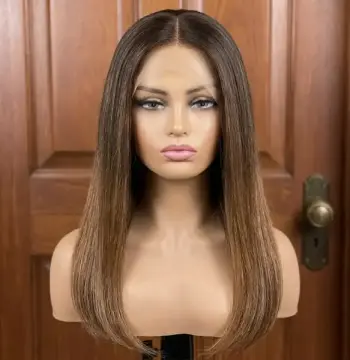
18" Ombre Dark Brown Transition Silky Straight HD Lace Front Human Hair Wig for Women
- Lengths
- 12" · 14" · 16" · 18" · 20" · 22" · 24"
- Lace
- 13x4 Lace · 13x6 Lace
- Cap
- Small · Medium · Large

HD Lace Front Human Hair Wig Soft Brown Wave with Face-Framing Highlights Pre-Plucked Natural Hairline Brazilian Hair
- Lengths
- 12" · 14" · 16" · 18" · 20" · 22" · 24"
- Lace
- 13x4 Lace · 13x6 Lace
- Cap
- Small · Medium · Large
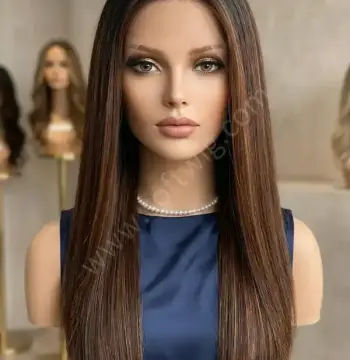
13x4 HD Lace Sleek Straight Soft Ombre Brown HD Lace Front Human Hair Wig for Everyday Effortless Style
- Lengths
- 12" · 14" · 16" · 18" · 20" · 22" · 24"
- Lace
- 13x4 Lace · 13x6 Lace
- Cap
- Small · Medium · Large