Choosing a wig for work
Pick something you'd describe as unremarkable and wear it on a Monday. Office wear is a long-duration, low-drama problem — comfort at hour eight and looking the same every day matter far more than looking impressive on day one.
This is a good fit if
- You'll be wearing it for full working days, most days
- You'd rather not field questions about your hair at work
- You want to put it on before a 7am train and forget about it
Look elsewhere if
- You want something that gets noticed
- You work somewhere physical, hot, or with safety headgear
- You only need it for occasional client meetings, where you can afford more upkeep
The office problem is duration
A wig for an event has to look excellent for four hours. A wig for work has to be tolerable for eight, five days a week, while you concentrate on something else.
That reverses several of the usual priorities. Density that looks generous in a photograph is heat and weight by 3pm. A deep lace front that photographs beautifully is one more thing to handle at 6.30am. Length that looks striking gets caught in the strap of your bag, twice, on the way in.
A practical work specification is simple: a measured cap size, manageable length and an attachment routine that needs no adjustment during the day. Those details matter more over a working week than an elaborate first impression.
Air conditioning is the office-specific factor
This is the one thing about office wear that isn’t obvious.
Air conditioning removes moisture from the air, and over eight hours it removes it from your hair too. Your own hair copes because your scalp keeps replacing the oils. A wig has no such supply — every bit of moisture that leaves is gone until you put it back.
The visible result arrives at around week three: the ends look dull and slightly rough, and start to catch on themselves when you brush. People usually blame the wig.
What actually helps, in order of how much difference it makes:
A light leave-in mist on the mid-lengths and ends, once or twice a week, before wearing rather than after. Not on the roots — you don’t need it there and it’ll go limp.
Lower heat and less of it. Dry air plus straighteners is a much harsher combination than either alone.
A day off between wearings if you can manage it, which lets the hair recover rather than starting each day drier than the last.
This is ordinary wig care under a specific pattern of dry air and collar friction. Adjust those conditions before assuming that early dryness or nape tangling proves poor-quality hair.
Managing the change in front of people you see daily
Colleagues are a specific audience: they see you every day, they notice differences, and most of them will say something.
What draws comment is change, not wigs. Hair the same colour and length as yesterday is invisible. A significant jump in length or shade on a Monday morning is a conversation, repeatedly, for a week.
So if you’d prefer not to discuss it, the practical approach is to match what people already associate with you. Start close to your own colour and length; if you want to go longer or lighter, do it in steps a few weeks apart rather than all at once.
If you’d rather deal with it head-on, saying it once — casually, to the person most likely to spread news — usually settles the whole thing faster than deflecting for a fortnight. There’s no correct answer here. There’s just less friction in consistency than in surprise, whichever route you take.
Keep the front edge at your natural hairline and make the position consistent from day to day. Correct placement is more useful than repeatedly restyling the hair to hide a cap that sits too high.
A workday morning routine
Work wear means putting the wig on at the worst possible time of day, in a hurry, often in poor light.
That argues for:
A cap that fits properly, so positioning it is one movement rather than a series of adjustments. This is the whole game.
A parting you don’t have to remake. A part that sits where you left it saves five minutes every morning. Parting freedom is a nice feature and not one you’ll use on a Wednesday.
No adhesive. Not a judgement on glue — just that a daily application, at speed, before coffee, is how hairlines get damaged.
Somewhere to put it at night. A stand keeps the cap in shape and lets it dry, which matters more than it sounds when you’re wearing the same thing five days running.
Two minutes, no mirror gymnastics. If a wig can’t do that, it’s an occasion wig regardless of how good it looks.
What to do about the commute
Small thing, real thing: the journey in does more damage to a work wig than the working day does.
Coat collars rub at the nape. Bag straps drag on one side. Rain and wind lift the front edge. Car headrests press the crown flat. All of it lands in the same forty minutes, twice a day.
Two habits fix most of it. Lift your hair out from under your coat collar when you put it on, the way you would with your own hair — that alone removes the main cause of nape matting. And if it’s genuinely windy, tie it back for the walk rather than fighting it, because the front edge is the part you can’t easily repair.
Neither of these is about the wig you buy. But if you’re choosing between a shoulder-length option and something considerably longer, the commute is a fair thing to weigh — the long one spends a lot more time under that collar.
What to look for on a listing
- Material
- Human hair, for heat and for looking ordinary under strip lighting
- Density
- 180% is what almost every listing will offer you. Offices are warmer than they feel, so let length do the work
- Length
- Shoulder length or a touch above, so it stays out of your way
- Shade
- Close to your natural colour, or a shade you've had before
- Cap
- Measured size, glueless, straps and combs
- Attachment
- Nothing you have to apply at 6.30am
Questions people ask
Will people at work notice?
They'll notice change, not the wig. If you turn up with hair that's the same colour and roughly the same length as yesterday, almost nobody registers anything. Arrive eight inches longer and blonde on a Monday and you'll be asked about it all week — which is fine if you want that, and worth avoiding if you don't.
Should I tell colleagues?
Entirely your call, and there's no obligation either way. Some people find saying it once removes the awkwardness for good; others never mention it and nothing happens. What causes more comment than either approach is looking noticeably different every few days.
Is air conditioning bad for a wig?
Dry air is. Air-conditioned offices strip moisture out of hair over a long day, and human hair has no scalp replenishing it, so it goes dry faster than your own would. A leave-in conditioner mist on the ends once or twice a week compensates for most of it.
Can I wear a wig on video calls?
Yes, and it's easier than in person — the parting is what a camera reads, so a clean part and a wig sitting at your natural hairline is all it takes. Overhead office lighting is less flattering than daylight for anything very shiny, which is another argument for human hair.
What about hats, helmets or headsets?
Headsets are fine, though the band flattens the crown over a long call — position it behind the hairline rather than across it. Anything tight and worn all day, including safety helmets, is a real friction problem and will wear the wig noticeably faster.
Matching wigs
What we'd point you at
Filtered on texture, length, shade. Cap, lining and attachment aren't in the catalogue data, so check those on the product page.

HD Lace Front Human Hair Wig Jet Black Straight Face-Framing Pre-Plucked Natural Hairline Brazilian Hair
- Lengths
- 12" · 14" · 16" · 18" · 20" · 22" · 24"
- Lace
- 13x4 Lace · 13x6 Lace
- Cap
- Small · Medium · Large
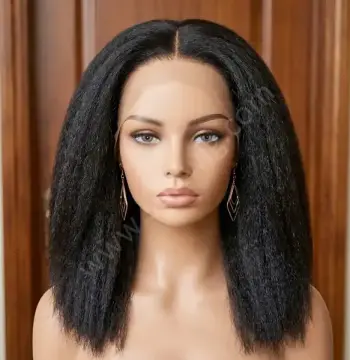
Rich Black Coarse Yaki Straight HD Lace Front Human Hair Wig Afro Kinky for Bridal Hairstyles
- Lengths
- 12" · 14" · 16" · 18" · 20" · 22" · 24"
- Lace
- 13x4 Lace · 13x6 Lace
- Cap
- Small · Medium · Large

24" Smooth Silk Straight HD Lace Front Human Hair Wig Deep Chocolate Brown with Bangs Density 180% Full for Office Look
- Lengths
- 12" · 14" · 16" · 18" · 20" · 22" · 24"
- Lace
- 13x4 Lace · 13x6 Lace
- Cap
- Small · Medium · Large

HD Lace Front Human Hair Wig Natural Dark Brown Straight Mid-Length Pre-Plucked Natural Hairline Brazilian Hair
- Lengths
- 12" · 14" · 16" · 18" · 20" · 22" · 24"
- Lace
- 13x4 Lace · 13x6 Lace
- Cap
- Small · Medium · Large