Choosing a wig colour you will still like in month three
Work out whether your skin runs warm or cool, then choose a shade one step softer than the one you are drawn to in the photograph. Studio lighting adds warmth and depth that your bathroom mirror will not, and a flat single colour is the version of a wig most likely to read as a wig.
Colour is the decision people make first and should make close to last. It is also the one where the photograph is least trustworthy, for a reason that has nothing to do with anyone being dishonest.
What the photograph is doing to the colour
Product photographs are lit to make hair look expensive. That means strong directional light, often warm, usually from more than one angle, with the hair arranged to catch it.
Two things follow. Warm shades — chestnut, caramel, honey — photograph richer than they are. And any colour with variation in it photographs far better than a flat one, because the light has something to work with.
Neither is a trick. But the light in your hallway is one overhead bulb, and it will not do any of that. Assume a shade will land a step flatter and a step cooler than the picture, and choose accordingly.
Undertone, briefly
Skin undertone is the colour underneath the surface tone, and it does not track how light or dark your skin is. Two people with the same depth of complexion can have opposite undertones.
The wrist test is the quickest version. In daylight, look at the veins on the inside of your wrist.
- Green-looking veins point to warm undertones, which sit well with golden browns, caramel, honey, warm blondes and chocolate.
- Blue or purple veins point to cool, which sits well with ash browns, espresso, jet black, and blondes described as beige or platinum rather than golden.
- If it is genuinely ambiguous, you are likely neutral, and most shades will work. This is the easy outcome, not the inconclusive one.
The rule this produces is soft. A cool-toned person in a warm shade does not look wrong, they look slightly ruddier. It is worth knowing which direction you are pushing, not worth agonising over.
The five families we stock
Rather than list shade codes, here is what the catalogue actually splits into and who each one tends to suit.
Natural black. The most forgiving from a distance and the least forgiving up close, because a single flat dark colour against skin shows every edge of the lace. Works with cool undertones and with any complexion depth. If you buy this, buy it with a root shadow.
Brown. The broadest family and where most people are happiest. Warm browns for warm undertones, ash and espresso for cool. This is also the family that hides regrowth mismatch best if you have your own hair underneath at the nape.
Dimensional — highlights, balayage, ombré. Colour that changes down the length. The largest part of what we stock, and the family that most reliably reads as real hair, because grown hair is never one colour. The style page goes into how the different techniques behave.
Blonde. The hardest to get right and the one where undertone matters most. Warm undertones want honey and golden; cool undertones want beige, ash or platinum. Get this backwards and it is visible from across a room. Our range here is small, so if blonde is non-negotiable, check what is in stock before you get attached to a shade.
Bold colour. Red, burgundy, anything unnatural. Undertone rules mostly stop applying, because nobody is reading this as your own hair. Choose it because you like it.
Why flat colour is the risky choice
The most common reason a wig reads as a wig is not the hairline. It is that the colour is identical from root to tip and identical across the whole head.
Hair that grew out of a head is not like that. There is regrowth at the root, sun exposure at the ends, and variation between strands. A wig with a root shadow and some tonal movement through the length is doing an impression of that. A flat one is not, and no amount of good lace compensates.
If you are choosing between two shades and one has some depth variation in it, take that one.
The bathroom test
Before you commit, do this. Find a photograph of the shade, put it on your phone, and go and look at it next to your face in the room where you get ready in the morning — not by a window, not under the bathroom’s brightest setting.
That is the light the wig will live in. A colour that survives it is a colour you will still like in month three.
If it goes wrong anyway, darkening a wig is achievable and lightening one really is not, which is another argument for choosing slightly lighter than your target rather than slightly darker.
Questions people ask
How do I tell if my skin is warm or cool?
Look at the inside of your wrist in daylight. Veins that read green suggest warm undertones, veins that read blue or purple suggest cool. If you cannot tell, you are probably neutral, which is genuinely easier — most shades will sit fine on you.
Should I match my natural colour?
For a first wig, or for anything meant to go unnoticed, yes. Matching what people already associate with your face removes one of the two adjustments you would otherwise be making at once. For a wig bought to be a change, ignore this entirely.
What is a root shadow and do I need one?
A darker few inches at the parting, imitating regrowth. It helps a great deal, because uniform colour right down to the scalp is one of the reliable tells. Most of our dimensional shades have it built in.
Will the colour change over time?
Slowly, and mostly towards warm. Washing lifts a little tone each time and sunlight does the rest, so a cool brown drifts warmer over months. Buying very slightly cooler than your target is a reasonable hedge.
From the catalogue
Where most people start
This page doesn't narrow the catalogue, so these are simply well-reviewed lace fronts rather than a match to anything above.
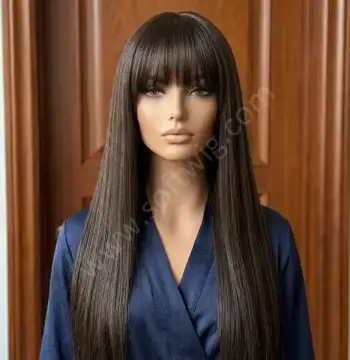
Silky Straight Rich Dark Brown HD Lace Front Human Hair Wig 24" with Bangs
- Lengths
- 12" · 14" · 16" · 18" · 20" · 22" · 24"
- Lace
- 13x4 Lace · 13x6 Lace
- Cap
- Small · Medium · Large

HD Lace Front Human Hair Wig Deep Chocolate Brown Body Wave Middle Part Pre-Plucked Natural Hairline Brazilian Hair
- Lengths
- 12" · 14" · 16" · 18" · 20" · 22" · 24"
- Lace
- 13x4 Lace · 13x6 Lace
- Cap
- Small · Medium · Large

HD Lace Front Human Hair Wig Soft Brown Wave Mid-Length Pre-Plucked Natural Hairline Brazilian Hair
- Lengths
- 12" · 14" · 16" · 18" · 20" · 22" · 24"
- Lace
- 13x4 Lace · 13x6 Lace
- Cap
- Small · Medium · Large

Ombre Blonde Brown with Highlights Sleek Straight HD Lace Front Human Hair Wig Short Bob Silky Soft for Casual Outings
- Lengths
- 10" · 12" · 14" · 16"
- Lace
- 13x4 Lace · 13x6 Lace
- Cap
- Small · Medium · Large